


OMeGA
-
Nous sommes ravis d'annoncer la 17e Conférence internationale sur l'évolution artificielle (EA 2026), qui se tiendra à Nice, en France, en octobre 2026.
EA est une conférence à but non lucratif qui rassemble des chercheurs travaillant dans les domaines suivants :
- le calcul évolutif
- l'optimisation et les métaheuristiques
- l'apprentissage automatique
- les systèmes complexes et l'intelligence artificielle
Cette édition mettra particulièrement en avant l'intersection passionnante entre les métaheuristiques et l'apprentissage automatique, un domaine de recherche en pleine expansion.
Nous encourageons vivement la participation en présentiel afin de favoriser les interactions scientifiques, les discussions et la collaboration.
Les articles acceptés seront publiés dans les actes de la conférence, et une sélection d'entre eux sera invitée à figurer dans la prestigieuse série Springer LNCS.
Plus d'informations : https://ea2026.inria.fr/ - Conférences passées :
-
Nous avons le plaisir d’annoncer l’organisation de l’université d’été 2026 sur les métaheuristiques hybrides associées à des approches d’apprentissage, qui se tiendra du 29 juin au 2 juillet 2026 à l’Université de Haute-Alsace (France).
Ce programme intensif de quatre jours explorera les méthodes d’optimisation modernes à la croisée de l’intelligence artificielle, de la recherche opérationnelle et de la science des données.
De nombreux problèmes d’optimisation concrets — rencontrés dans la logistique, les systèmes énergétiques, les transports et les soins de santé — sont de grande envergure, non linéaires et soumis à de nombreuses contraintes. Pour relever ces défis, les chercheurs s’appuient de plus en plus sur des approches hybrides combinant l’optimisation mathématique, les métaheuristiques et l’apprentissage automatique.
Qu’apprendront les participants ?
• Modélisation mathématique et méthodes d’optimisation exacte (MILP, Gurobi)
• Métaheuristiques et algorithmes approximatifs
• Apprentissage automatique pour l’optimisation basée sur les données
• Modèles de substitution pour les problèmes nécessitant des calculs intensifs
• Hyper-heuristiques pour la sélection et la génération d’algorithmes
Les participants travailleront sur une étude de cas pratique portant sur la planification de la recharge des véhicules électriques (EVCS), illustrant comment les approches hybrides d’IA peuvent relever les nouveaux défis en matière de mobilité durable et de systèmes énergétiques.
Défi final :
Le dernier jour, les participants prendront part à un défi pratique d’optimisation basé sur le problème EVCS.
Trois prix seront décernés aux solutions les plus performantes.
En Salle 201 Bâtiment K, FST, 18 rue des Frères Lumière, Mulhouse
-
The study of ship stability under random sea states is an important problem in naval engineering. In this talk, we focus on the roll motion of a ship subjected to beam seas and random wave excitation. We consider a nonlinear stochastic model describing the ship roll dynamics, coupled with filtered random excitation. The resulting dynamics can be described by a high-dimensional Fokker–Planck equation. We develop a second-order asymptotic approach to approximate its solution and investigate the long-time behavior of the corresponding stochastic system. Particular attention will be paid to the mathematical structure of the model and the asymptotic analysis of the probability density. Some numerical aspects related to the solution of the Fokker–Planck equation will also be briefly discussed. The objective is to provide a mathematical and computational framework for studying ship responses under random sea conditions and their implications for ship stability.
-
TBA
-
TBA
-
TBA
- Conférences passées :
-
Il est habituel de présenter les résultats d’un championnat sportif sous la forme d’un tableau où figure sur une des colonnes le nombre de victoires par équipe. Lorsque n équipes se sont toutes affrontées, ce vecteur peut devenir (0,1,\ldots,n-1) pour un championat hiérarchisé à l’extrême, ou bien au contraire un vecteur dont les composantes sont d'avantage ramassées autour de (n-1)/2. Un théorème de E. Landau, généralisé par Moon, exprime une condition nécessaire et suffisante à être ce vecteur, ceci à l’aide de l’ordre partiel de la « majoration ». Alors que cette condition se traduit facilement en terme d’espérance conditionnelle, c’est seulement récemment en 2022 qu’une démonstration probabiliste du théorème de Moon a été proposée par Aldous et Kolesnik. Dans cette démonstration les auteurs s’appuient sur une image, celle d’un modèle statistique « du football ». Notre travail, avec Gaoyue Guo (Paris Saclay) et Wenpin Tang (Columbia University), a consisté à envisager cette démonstration dans le cadre d’un problème de transport martingale afin de la rendre plus tangible et de d'obtenir de nouvelles propriétés.
-
Il existe plusieurs notions de borne de courbure de Ricci pour les graphes et les groupes. Y. Ollivier a proposé une approche via le transport optimal à la Lott-Villani-Sturm. D. Bakry et M. Emery ont proposé une autre approche via la théorie des diffusions et la formule de Bochner en géométrie riemmanienne. Le but de l’exposé sera de montrer, via cette deuxième approche, comment donner des versions discrètes de résultats classiques en analyse sur les variétés (Bisoop-Gromov, Li-Yau, Harnack, Poincaré, …).
-
Optimal stopping theory, developed through seminal works of Dynkin, Shiryaev, and others, is a fundamental topic in probability, stochastic control, and mathematical finance. Classical approaches typically rely on dynamic programming principles and the Snell envelope, which characterize the value function through backward recursive procedures. While these methods provide a powerful theoretical framework, alternative computational approaches have also been investigated.
In this talk, I will first review some classical optimal stopping problems and discuss Irle’s forward algorithm for finite-state Markov processes. In contrast to traditional backward methods, Irle’s approach constructs the value function through a forward iterative procedure, leading to an efficient computational framework and new insights into the structure of optimal stopping problems.
Motivated by these ideas, I will then consider a two-player zero-sum stopping game driven by a homogeneous Markov process on a finite state space. Such games extend optimal stopping problems to a setting with competing players and strategic interactions. I will present a new algorithm for computing the value function of the game, which can be viewed as a game-theoretic extension of Irle’s forward algorithm. The convergence of the method, the number of iterations required, and several numerical examples illustrating its performance will also be discussed. -
The problem of estimating the maximal number H(m) of limit cycles that planar polynomial vector fields of degree m can exhibit has long been a central question in the qualitative theory of planar dynamical systems. A natural extension to the threedimensional space is to study the maximum number N(m) of limit tori that can occur in spatial polynomial vector fields of degree m. In this work, we focus on normally hyperbolic limit tori and show that the corresponding maximum number N_h(m), if finite, increases strictly with m. More precisely, we prove that N_h(m+1) ⩾ N_h(m)+ 1. Our proof relies on two central results established in this paper. The first is that the normal
hyperbolicity of compact invariant manifolds is preserved under time reparametrizations.Despite the fundamental nature of this statement, a complete proof has, surprisingly, not previously appeared in the literature, except under rather restrictive assumptions on the flow restricted to the invariant manifold. The second result concerns the torus bifurcation phenomenon near Hopf–Zero equilibria in spatial vector fields. While the conditions for such bifurcations are typically expressed in terms of higher-order normal form coefficients, we derive explicit and verifiable criteria for the occurrence of torus bifurcation, assuming only that the linear part of the unperturbed vector field is in Jordan normal form.
This approach not only circumvents intricate computations involving higher-order normal forms but also ensures the normal hyperbolicity of the bifurcated torus.
-
The area of stochastic partial differential equations has seen rapid progress over the past decade, spurred by the introduction of the theory of regularity structures and of para-controlled calculus. Despite the close connections of singular SPDEs to physical phenomena, the theory of singular SPDEs has largely been developed homogeneous settings, involving constant-coefficient operators.First I shall motivate the study of SPDEs in heterogeneous environments using the examples of Φ^4 as a model of ferromagnetism and the parabolic Anderson model as it relates to branching processes.After recalling the renormalisation of the classical homogeneous versions of these equations, I will describe what changes in the variable-coefficient setting. In particular, I will present a natural choice of renormalisation functions that is local and, for sufficiently covariant regularisations of the noise, explicit.The talk will be non-technical and focused on the main ideas.
-
In this talk, we consider a compact hyperbolic surface with finite order singularities and its unit tangent bundle.
We consider also the twisted Selberg zeta function associated with an arbitrary, finite-dimensional representation of the fundamental group of the unit tangent bundle.
We will present recent results concerning a relation between the twisted Selberg zeta function and the regularized determinant of the twisted Laplacian. The main tool we use is the Selberg trace formula. If the surface has no finite order singularities, we obtain as a corollary a corresponding relation. These results can be viewed as an extension to the non-unitary twists case of the results by Sarnak and Naud. This is joint work with Jay Jorgenson and Lejla Smajlovic. -
Given a germ of analytic vector field ∂, let ∂= ∂_ss + ∂_nilp be its unique formal Jordan decomposition, where ∂_ss is its semi-simple component and ∂_nilp is its nilpotent component. When ∂ is logarithmic, we define the Bruno ideal B(∂) as the formal locus where the semi-simple and the nilpotent components are collinear, that is, the vanishing locus of ∂_ss ∧ ∂_nilp.
We prove the following result originally stated by A. D. Bruno: If the eigenvalues of ∂_ss satisfy an arithmetic condition, then B(∂) is analytic and the restriction of ∂ to its zero set V is analytically normalizable.
This is a joint work with Daniel Panazzolo. -
Une triangulation d’un ensemble de points dans le plan euclidien est dite de Delaunay si chaque cercle circonscrit à un triangle ne contient aucun autre sommet de la triangulation. Son extension à des surfaces, ainsi que certains algorithmes permettant de la calculer, se heurte à des difficultés topologiques (genre de la surface) et géométriques (systole de la surface).
Cet exposé introduira la notion de triangulation de Delaunay, et présentera des méthodes de calcul permettant de la calculer comme l’algorithme de flip ou de Bowyer-Watson. Nous nous focaliserons ensuite sur ce-dernier, en l’étendant d’abord au tore, puis aux surfaces hyperboliques, en passant par la surface de Bolza. Aucun prérequis en géométrie hyperbolique, topologie ou algorithmique n’est nécessaire pour suivre l’exposé. -
In this talk I will report on a recent joint work with Chiara Esposito and Michael Heins on convergence properties of Drinfel’d twists. A formal Drinfel’d twist is a formal power series in \(hbar\) with entries in the tensor power of the universal enveloping algebra of a Lie algebra with itself such that certain algebraic conditions are satisfied. These algebraic properties can either be interpreted as defining an associative formal product on the corresponding Lie group by left translations. Alternatively, they can be used to define formal associative deformations of any algebra on which the Lie algebra acts by derivations by a universal deformation formula (UDF). We study now the situation of locally convex algebras and consider the space of $R$-analytic and \(R\)-entire vectors with respect to the representation. These spaces are generalizations of the usual analytic and entire vector depending now on a parameter $R$ which controls the growth of their Taylor coefficients. Once the twist satisfies a certain continuity condition we show that one obtains convergence of the UDF thus leading to a non-formal deformation. Several examples illustrate that this is a promising and rich scenario to obtain convergence deformations.
-
Après un bref rappel historique sur les B-séries, nous introduirons le cadre catégorique naturel à leur étude.Nous verrons ensuite que certaines techniques classiques d’algèbre supérieure fournissent des résultats d’analyse numérique via ce contexte catégorique.
-
Invariant compact manifolds, such as equilibria, periodic orbits, and invariant tori, provide important information about the dynamics of differential systems. This knowledge is significantly increased when we can describe the behavior of nearby trajectories. In this talk, we present conditions that ensure the existence of invariant tori in perturbed differential systems, along with results on their regularity, stability, and dynamics. These conditions are based on higher-order averaged equations and extend classical theorems by Krylov, Bogoliubov, Mitropolsky, and Hale. As an application, we also explore a three-dimensional version of Hilbert’s 16th Problem, focusing on the number of isolated invariant tori in 3D polynomial vector fields.
IMTIS
- Conférences passées :
-
09h30 – 10h00
Soumen Indu
Titre : Gestion intelligente de la surveillance de la consommation d'énergie à l'IUTLab à l'aide de techniques d'apprentissage automatique
Encadrant : Patrice Wira
10h00 – 10h30
Mbarek Oulghazi
Titre : Trames de Gabor non stationnaires quiltées : vers des représentations temps-fréquence adaptatives et inversibles
Encadrant : Ali Moukadem
10 h 30 – 11 h 00
Muhammad Sami Ur Rasul
Titre : Les fibres comme motifs de test de résolution optique pour l’évaluation par nanoscopie sans marquage
Encadrant : Olivier Haeberlé -
10 h 00 – 10 h 30
Baptiste Hubner
Titre : Localisation parcimonieuse de particules en microscopie
Encadrant : Jean-Baptiste Courbot
10 h 30 – 11 h 00
Abdeljalil El Boughdadi
Titre : Analyse et modélisation d’une maison intelligente réelle pour la création d’une base de données dédiée à la détection d’anomalies et à la surveillance flexible de la charge
Encadrant : Djaffar Ould Abdeslam
11 h 00 – 11 h 30
Raza Hassan
Titre : Étalonnage de caméra pour l’estimation de la profondeur à partir de plusieurs vues
Encadrant : Stéphane Bazeille -
(11 juin 2026 - 18:30 a 20:00) — Stéphane Bazeille — Comment les robots perçoivent-ils le monde ? UP du Rhin, salle de conférences de la Cour des chaînes, 13 rue des Franciscains 68100 – Mulhouse
-
(4 juin 2026 - 15:00) — Salem Ait Messaoud — Simulation et édition de défauts par 3d Gaussian Splatting IUT Mulhouse, salle A004
-
(21 mai 2026 - 14:00) — Titouan Sérandour — Un modèle d’apprentissage profond pour la détection des nébuleuses planétaires sur des images astronomiques IUT Mulhouse, Salle A004
-
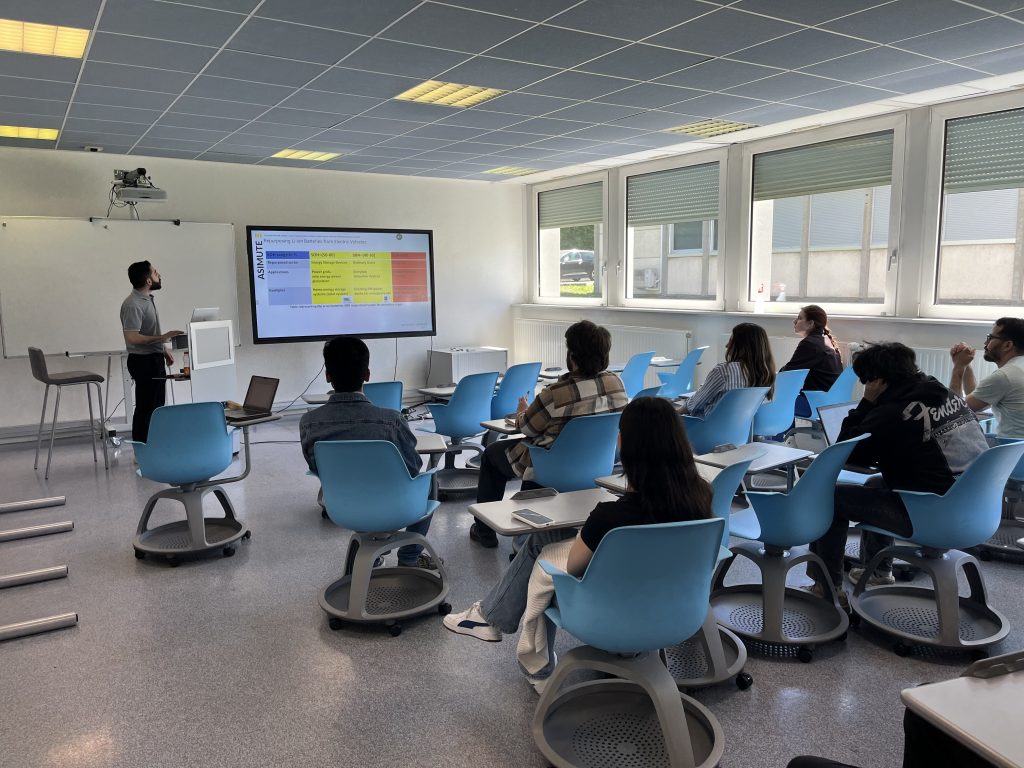
-
(2 avril 2026 - 14:00) — Julie Munsch — Modèles graphiques et probabilistes pour la maintenance prédictive application à la classification et à la prévention d’évènements IUT Mulhouse, Salle A004
-
(19 mars 2026 - 14:00) — Carlos Alberto Chacon — Microscopie tomographique diffractive à double vue IUT Mulhouse, Salle A004
-
(5 mars 2026 - 14:00) — Simon Schabat — Segmentation des chromosomes dans des images de microscopie à fluorescence IUT Mulhouse, Salle A004